Why Did Benjamin Franklin Create the Liberal Arts Academy
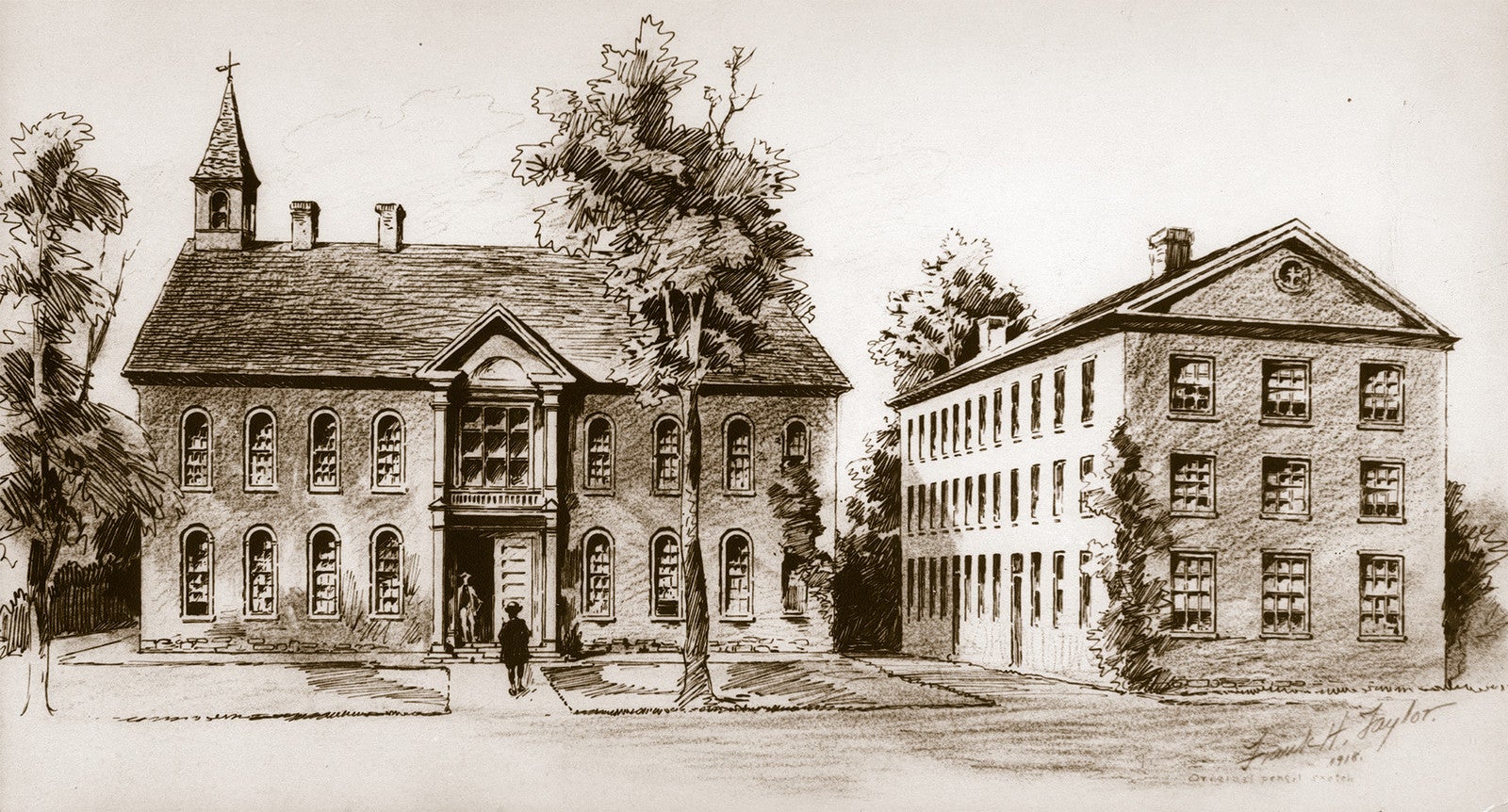
Fourth Street Campus, College of Philadelphia: Academy/College Building and Dormitory/Charity School, 1918 sketch
Franklin'south Vision
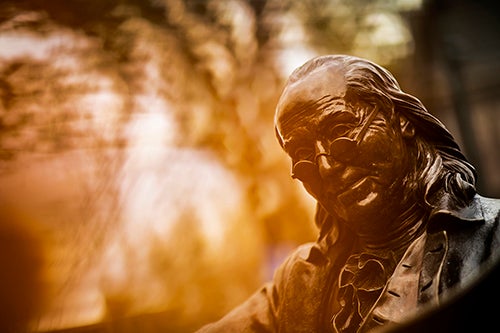
In 1749, Benjamin Franklin—printer, inventor, and time to come founding father of the United States—published his famous essay, "Proposals Relating to the Pedagogy of Youth," circulated it among Philadelphia'southward leading citizens, and organized 24 trustees to form an establishment of higher pedagogy based on his proposals. The group purchased the building and in 1751, opened its doors to children of the gentry and working class alike as the Academy and Charitable School in the Province of Pennsylvania. Franklin served as president of the institution until 1755 and continued to serve as a trustee until his decease in 1790.
Franklin's educational aims, to train young people for leadership in business organisation, government, and public service, were innovative for the fourth dimension. In the 1750s, the other Colonial American colleges educated young men for the Christian ministry, merely Franklin'due south proposed program of study was much more like the modernistic liberal arts curriculum. His young man trustees were unwilling to implement most of his so-radical ideas though, and Penn's offset provost, William Smith, turned the curriculum dorsum to traditional channels shortly after taking the helm from Franklin.
In addition to challenging the educational conventions of the mean solar day, Franklin pushed boundaries that moved scientific discipline and society frontward and helped shape America's very nationhood. He was a fellow member of the 2nd Continental Congress, a drafter and signer of the Declaration of Independence and U.S. Constitution, and played a pivotal role in recruiting French aid for the Americans during the Revolutionary War. Franklin later signed the Treaty of Paris, officially ending the conflict with the British Empire.
His broad cognition spanned multiple disciplines, and far from regarding it as an stop in itself, he saw cognition every bit an asset that required practical awarding to be of value. His many essential inventions range from bifocals and the lightning rod to the iron furnace stove and odometer.
Beyond that, the civic institutions that Franklin helped launch include the country's outset subscription library (1731) and kickoff hospital (1751), in addition to what would go America's first academy, the University of Pennsylvania, in 1749.
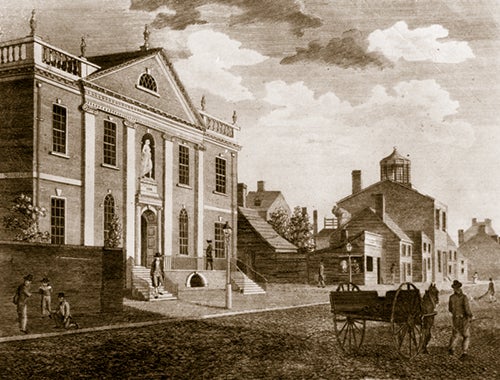
In the years that followed, Penn went on to obtain a collegiate charter (1755), graduate its first class (1757), establish the commencement medical school in the American colonies (1765) and become the first American institution of higher education to exist named a university (1779). In 1802, the University expanded to another campus, simply by the 1860s had outgrown even that space, and then in 1872 the trustees built a new campus in the street-car suburb of W Philadelphia.
Franklin's Influence & the Modern University
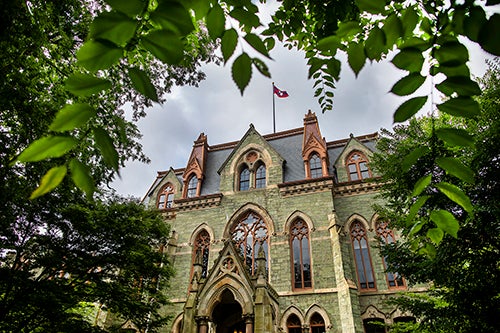
To this twenty-four hour period, Penn'due south 299-acre West Philadelphia campus reflects its rich heritage—a heritage closely bound with the birth of the United States—boasting more than than 180 buildings and many notable landmarks, including the nation'southward first student union and offset double-decker college football stadium.
The 190 research centers and institutes on campus also reflect the University's innovative, borough-minded, and pragmatic creator: More than 250 years after Ben Franklin broke new ground in founding Penn, its faculty, students, and alumni go along to brand breakthroughs in research, scholarship, and education. Its many subsequent "firsts" include the globe's starting time collegiate business school (Wharton, 1881); the earth's commencement electronic, large-scale, general-purpose digital calculator (ENIAC, 1946); and the first woman president of an Ivy League institution (Judith Rodin, inaugurated in 1994); every bit well as the first adult female Ivy League president to succeed another woman (Amy Gutmann, inaugurated in 2004).
From campus walkways engraved with Franklin's words of wisdom to the University's most of import strategic initiatives such as the Penn Integrates Cognition Professorships, the President'due south Engagement Prizes, and the President'due south Innovation Prizes, Penn continues to educate and inspire future leaders to move our now-global society forrard.
Additional information on Penn'southward heritage is available at University Archives & Records Center.
Source: https://www.upenn.edu/about/history
0 Response to "Why Did Benjamin Franklin Create the Liberal Arts Academy"
Publicar un comentario