whats the best reverse osmosis system to remove uranium
Uranium Mitigation From Drinking H2o
Uranium Mitigation From Drinking Water
Uranium is a common constituent of many rocks in the Piedmont and mountains of NC. Recent well water testing in Eastern Wake County by the Wake County Department of Environmental Services has shown that elevated levels of uranium are nowadays in many wells. This issue besides extends to large portions of Franklin Count as well. This is due to the large bodies of granite that underlie these areas, which accept elevated levels of uranium, radium and radon. Uranium is the heaviest naturally-occurring chemical element on the Periodic Tabular array with diminutive number 92. All uranium is radioactive and the ascendant uranium isotope is Uranium-238 (238U). 238U comprises almost 99.27% of all naturally-occurring uranium. The other main isotope, comprising about 0.72% is 235U. Uranium was formed during the time when planets were first forming and since the uranium isotopes have unusually long half-lives, much of this material is notwithstanding present on Globe. The half-life of 235U is 4.five billion years and for 238U information technology is 700 million years. The reason the 238U is the near abundant over 235U is because of this much longer half-life ‑ this means it takes much longer to decay and disappear.
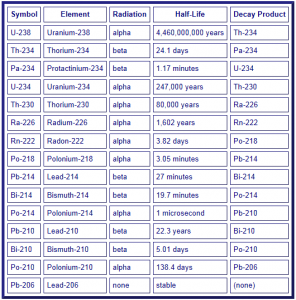
The radioactive decay path of 238U is shown in the diagram below. You tin can see a long progression of intermediate elements, or daughter products (progeny), that occur during the radioactive decay of uranium. From this tabular array you can see that many of the daughter products themselves have very short half-lives. For example, 234Th decays in 24.ane days and 234Pa decays in i.17 minutes. As these elements decay, radiation is given off, commonly in the form of blastoff particles, beta particles (see column 3 below) and gamma rays. These radioactive emissions are explained beneath.
Alpha particles
Alpha particles are essentially helium nuclei and are comprised of 2 protons and ii neutrons. These particles are the to the lowest degree penetrating radiation given off during radioactive decay and are not dangerous in terms of external homo exposure. That is, they tin exist stopped past a sail of newspaper and are not energetic enough to penetrate human peel. However, they should non be consumed because in one case inside the body these particles can hands enter and damage cells. Therefore, the EPA has set a Maximum Contaminant Limit (MCL) limit for Gross Alpha at fifteen picoCuries per liter (pCi/50).
Beta Particles
Beta particle are loftier-free energy electrons that are emitted during radioactive decay and are more energetic than alpha particles. These can penetrate skin and cause prison cell damage and therefore contribute to radiation exposure. The EPA has fix an MCL for beta particles are 4 millirems per year (mrem/yr). On the other paw, if inside the torso, beta particles are not as dangerous because they are less probable to be absorbed past the cells and more often than not pass right through them.
Gamma Rays
Gamma rays are a high-free energy form of electromagnetic radiation similar to X-rays. Gamma radiation is about dangerous when outside the body because information technology tin can penetrate skin and damage living cells. Gamma rays are another class of emission usually accompanying the main forms of radioactive decay.
Removal of Uranium from Drinking Water
Based on the tabular array above you tin meet that the disuse of 238U involves many steps. The end consequence, if 238U is allowed to disuse all the manner, information technology eventually becomes 206Pb, which is normal stable lead. In terms of Drinking Water Standards, the most imports things that are regulated by the EPA are: Uranium, Radium, and Radon. Mitigation of radon and radium is discussed separately.
For uranium, the subject of this memo, the MCL set by the EPA is 30 mg/50 (micrograms per liter). Since uranium is an alpha particle generator, removing it also reduces Gross Alpha. In drinking h2o uranium exists equally complex anionic groups associated with carbonate:
- UO2(CO3)ii 2−
- UO2(CO3)three 4−
- UOtwo(CO3)(OH)3 −
Removal past Ion Exchange
These complex anions all have a negative charge associated with them and therefore can be removed using an ion-exchange process. For a point-of-entry arrangement, a special strong base anion resin called A300E is used which can capture the uranium complexes. This system works simply like a regular water softener except instead of removing calcium hardness, the anion commutation method removes uranium ions and usually achieves improve than 98% reduction. It uses normal NaCl salt equally the regenerant and the exchange is betwixt the U-complexes and chloride ion (Cl–). For good uranium reduction it is important to have enough resin in the tanks for acceptable contact fourth dimension for the exchange. The uranium mitigation systems can be configured in one of 2 means: 1) equally a stand-alone system and ii) as a mixed resin bed organisation with A300E resin layered with normal water softener resin (C100E) for removal of hardness and radium.
The option betwixt using a mixed resin bed depends on the actual uranium concentration and also the level of hardness. If the hardness is high ‑ greater than 6-7 grains per gallon, using dissever systems for uranium reduction and water softening is recommended to avoid mineralization inside the water softener valve.
If the hardness is low, then a mixed resin bed organization works to solve both uranium and hardness (and radium) in a single system. This reduces the amount of salt that is used and also takes upwardly a smaller footprint. The maintenance on a uranium ion substitution system is merely similar a water softener ‑ you must add together salt periodically to regenerate the resin. The A300E resin should last up to 9 years if maintained properly and it is always a good thought to have an annual uranium test washed to verify the levels in the treated water.
Removal past Reverse Osmosis
Since uranium is a heavy metal and is not absorbed by the peel, many people choose to remove the element only from their drinking h2o using a reverse osmosis drinking water arrangement. Reverse Osmosis (RO) is the most common blazon of drinking h2o purification method to purify drinking and cooking water. These systems are mostly point-of-use (POU) only and treat h2o at a designated faucet for drinking and cooking water only.
RO utilizes a semi-permeable membrane and finer removes about 95% of ALL contaminants in drinking water. Since uranium is a heavy metal and large in size, it is easily remove by the RO process. RO also removes a huge number of other contaminants including all metals, heavy metals, radioactive metals, asbestos, silica, pharmaceuticals and other pollutants.
It is also possible to install a large RO system to treat all the water in the dwelling house (whole-business firm RO). This system is considerably larger and more expensive than the POU system and involves much larger membranes for amend product rates, as well as large storage tanks and a repressurization organisation.
All RO systems have a discharge stream that carries away the contaminants rejected by the membrane and this stream is usually sent to the drain.
Test your water to make up one's mind if water treatment is necessary and which option is right for you lot.
Source: https://www.kineticoadvancedwatersystems.com/blog/uranium-mitigation-from-drinking-water/
0 Response to "whats the best reverse osmosis system to remove uranium"
Publicar un comentario